sales@titaniscm.com
/ administration@titanscm.pro
0086-771-5592620
message
1

Ascending Pipe Pre-cast Refractory
Main Composition: Al2O3 Application: Coke oven, etc Capacity: 500 tons per month Color: White Size: As your requirements
Product Introduction
The lining of ascending pipe upper structure is made of monolithic casting refractory; bottom structure is made of high temperature glazed refractory. There is less carbon deposit on the surface of the pre-cast refractory. New type pre-cast plays a very good role in thermal insulation.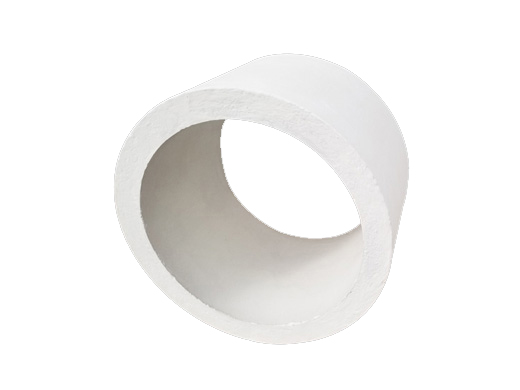
Features
1. Smooth surface. 2. Simple structure. 3. Long working life. 4. Energy saving.
Application
It's mainly for coke oven.
| ITEM | GLAZED |
| ω(Al2O3) /% >= | 50 |
| ω(MgO) / % >= | 2.5 |
| Apparent Porosity /% <= | 28 |
| Bulk Density /g/ cm3 >= | 2.1 |
| Cold Crushing Strength /MP >= | 40 |
| Rupture Strength /MP >= | 4 |
| Thermal Conductivity/W/ (m·K)1000℃ (Heating side) <= | 1.2 |
| Thermal Shock Resistance (1100℃, water cooling) /cycle >= | 50 |
| ITEM | NORMAL | |
| ω(Al2O3) /% >= | 50 | |
| ω(MgO) /% >= | 2.5 | |
| Apparent Porosity /% <= | 28 | |
| Bulk Density /g/cm3 >= | 2.1 | |
| Cold Crushing Strength /MPa >= | 110℃*24h After drying | 35 |
| 1350℃*3h After firing | 40 | |
| Rupture Strength /MPa >= | 110℃*24h After drying | 3.5 |
| 1350℃*3h After firing | 4 | |
| Thermal Conductivity/W/ (m·K)1000℃ (Heating side) <= | 1.2 | |
| Thermal Shock Resistance (1100℃, water cooling) /cycle >= | 50 | |
Comparison between new type and traditional type
| NEW TYPE | TRADITIONAL TYPE |
| Smooth surface, less joints, less carbon and dust deposition | Traditional ascending pipe is installed by refractory bricks, after installation, the surface is rough and has many joints. It is easy to accumulate coal and dust. |
| Simple structure New type consists of three parts: glazed base, glazed bottom pipe, monolithic casting upper pipe. | Complicated structure |
| Easy to install the ascending pipe, using the bolts to link the three parts. | Complicated installation |
| Reduce the repair times and save the cost. | Frequent repair and high cost |
| Long working life | Short working life |
| Solve the gas leakage problems, reduce the environment pollution and heat dissipation, lead to energy saving. | Long time mechanical operation and chemical damage on the joints, leading the joints to become bigger. Gas leakage and environment pollution. |
top